Our unique collection of sailing heritage
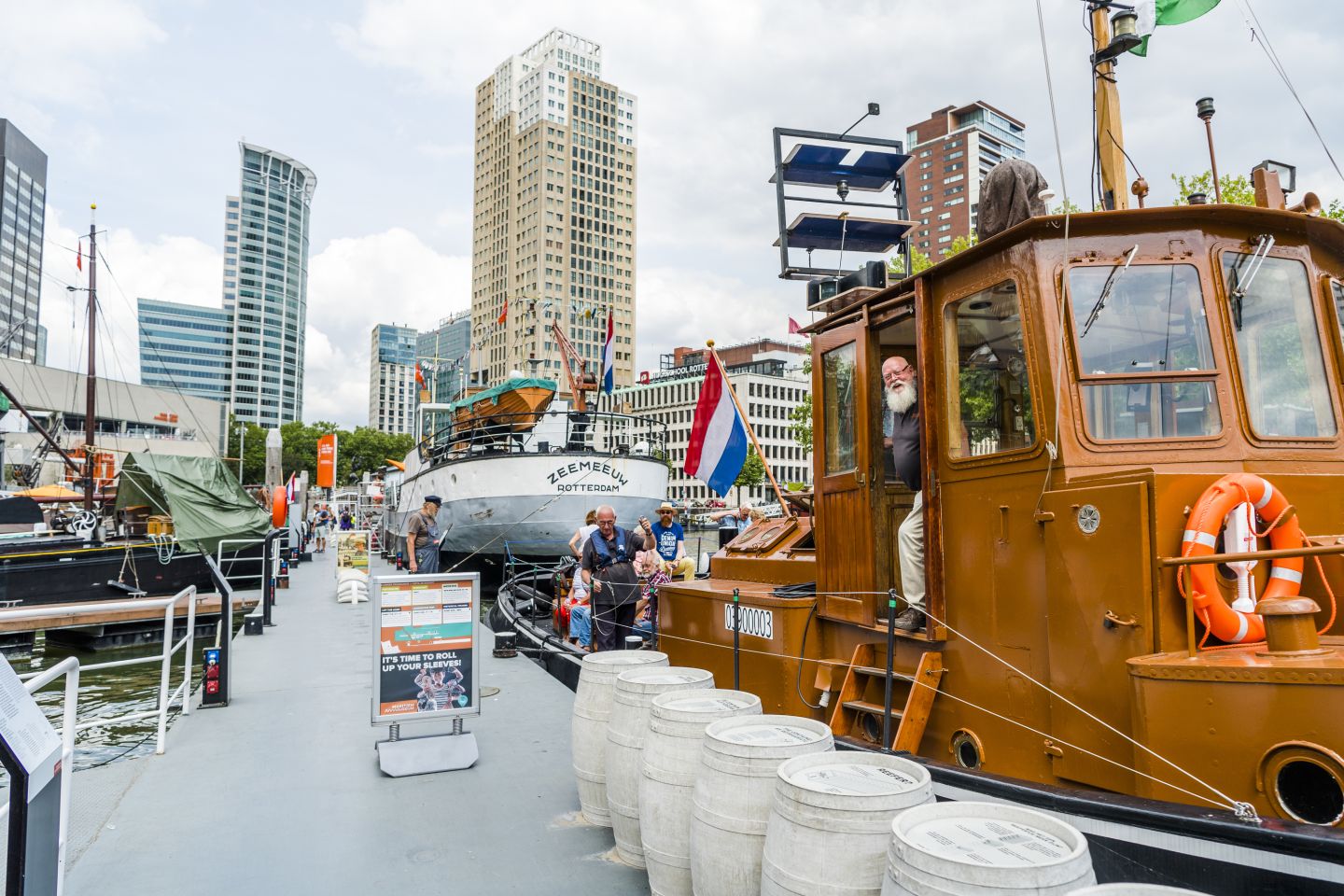
The Maritime Museum Harbor houses a collection of unique sailing heritage, ranging from imposing harbor cranes to steam tugs.
Discover our ships and cranes. You’re welcome to come aboard during the summer months! During the winter season (November 1 through March 31), the museum ships are closed, but the museum pier and workshops remain open as usual.
Our ships
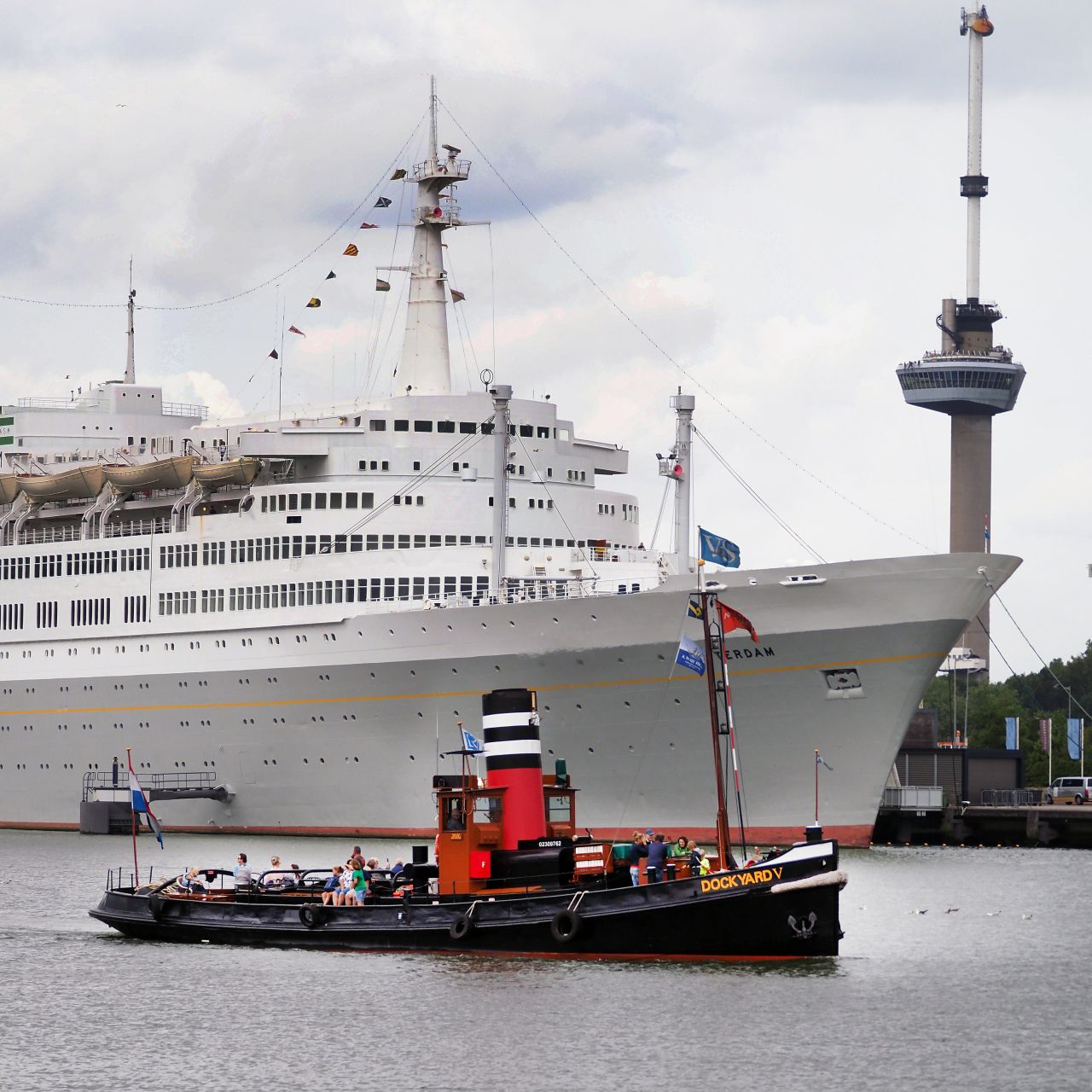
The ‘Dockyard V’ is one of the fleet of steam tugs belonging to the Rotterdam Dry Dock Company (RDM). These sturdy, powerful steam tugs were the workhorses of the Port of Rotterdam in 1950.
Originally, the ‘Dockyard V’ was built in Rotterdam for a Russian client who intended to use it in the port of Murmansk. However, due to World War II, it was never delivered. The RDM subsequently decided to add the tugboat to its own fleet. Around 1950, the ship was used to tow seagoing vessels that needed repairs. The steam tug also assisted in towing newly built ships that were launched at the RDM and needed to be towed to the finishing dock. The ‘Dockyard V’ also transported RDM personnel who had to perform repairs on board ships. This earned the steam tug the nickname ‘service bike.’
Did you know you can rent this ship?
The Maritime Museum offers the opportunity to charter this historic museum ship for an exclusive cruise through the Port of Rotterdam.
The ‘Volharding 1’ is one of the Netherlands’ last coal-fired steam tugs. It has a very powerful triple-expansion steam engine. Do you know which famous ship also used this type of steam engine? The ‘Titanic’! The ‘unsinkable ship’ that sank on its maiden voyage in 1912 after colliding with an iceberg.
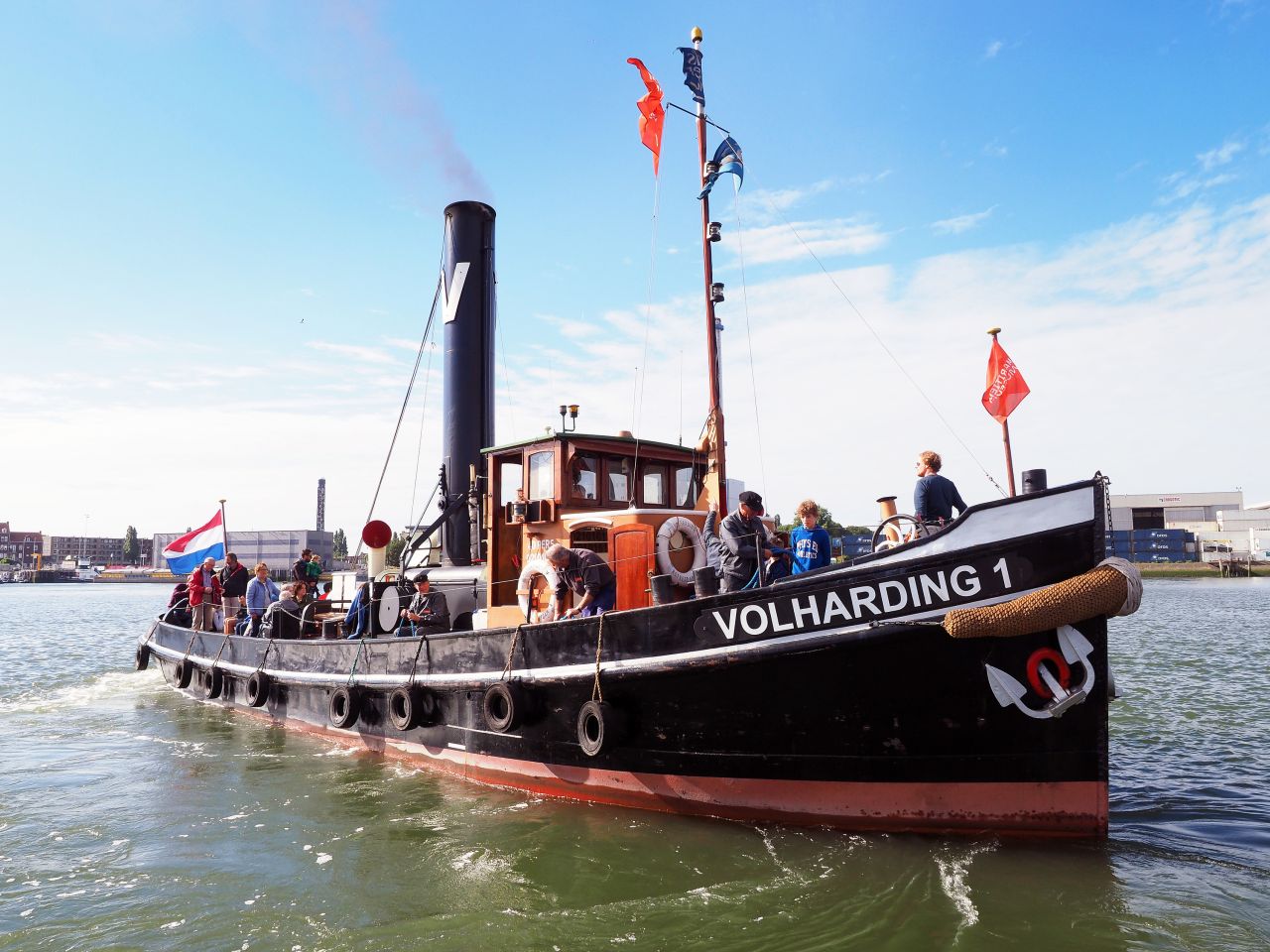
Until World War II, the “Volharding 1” operated under the name “Harmonie 6,” primarily as a Rhine tugboat bound for the Ruhr region in Germany. The German steel industry had a great need for raw materials such as iron ore, which was shipped through the Port of Rotterdam. On the return trip, the ship mainly carried coal, intended for fuel. In 1951, the ‘Harmonie 6’ arrived in Rotterdam. It was converted into a harbor tugboat and subsequently served for sixteen years in the Port of Rotterdam as the ‘Volharding 1’. Due to the increasing size of seagoing vessels and the motorization of inland shipping, the steam tugboat was no longer operated commercially after 1967.
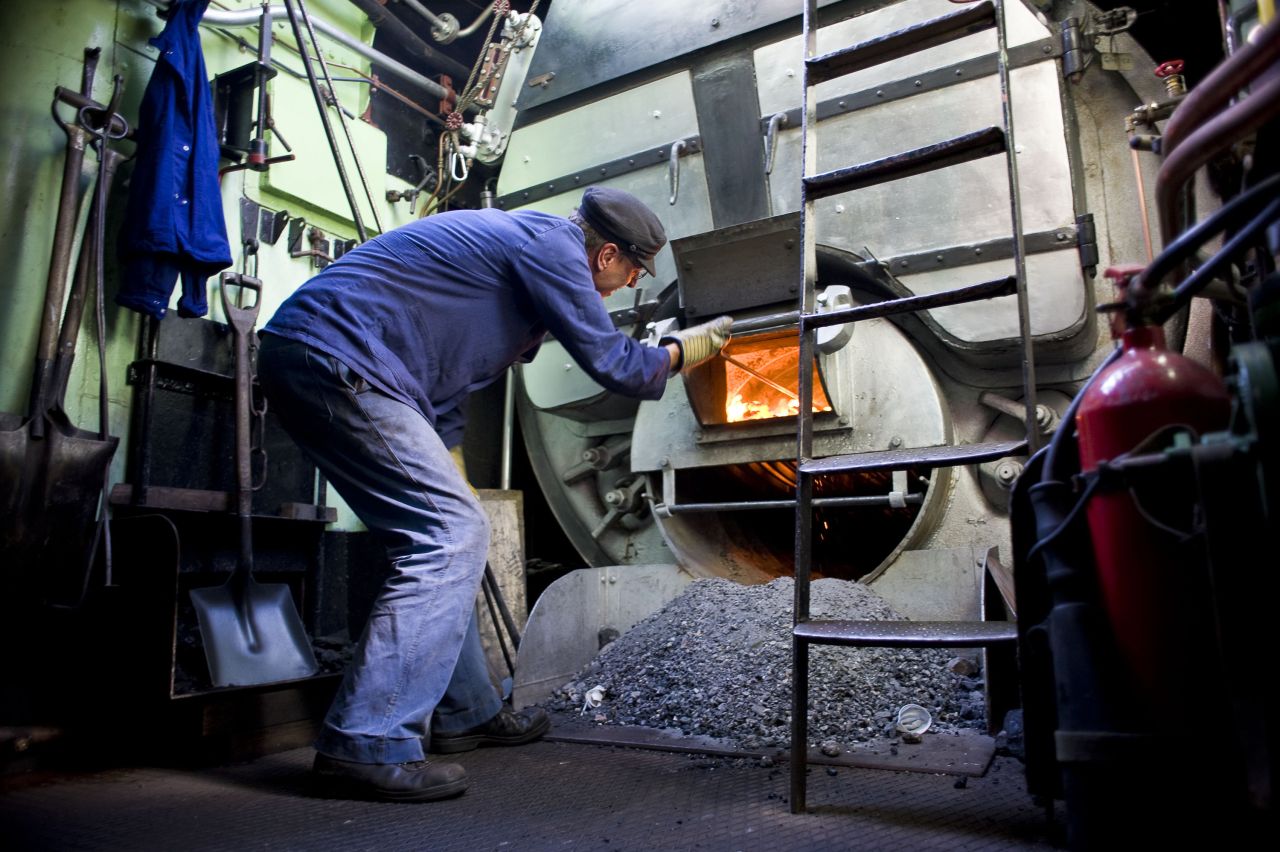
Extra-powerful triple-expansion steam engine
The Volharding is equipped with a triple-expansion steam engine. In this system, the exhaust steam from the cylinder is not returned to the boiler to be reheated, but is directed—at a lower pressure—to a second cylinder. This second cylinder operates on the same principle as the first. The spent steam from that second cylinder then goes—at an even lower pressure—to a third cylinder where the same process repeats. Only then is the used steam discharged. The trick is that the angle at which the connecting rods are attached to the crankshaft differs by exactly 120 degrees. And that adds up to exactly one revolution of the crankshaft. This also means that the engine delivers six power strokes (two per cylinder) with every revolution. That is why a triple-expansion steam engine is particularly powerful.
Did you know you can rent this ship?
The Maritime Museum offers the opportunity to rent this historic museum ship for an exclusive cruise through the Port of Rotterdam.
Port Service Boats 2 and 20 are part of a fleet of port service vessels that defined the landscape of the Port of Rotterdam between 1950 and 1990. The port service boats served as patrol vessels, fireboats, and icebreakers.
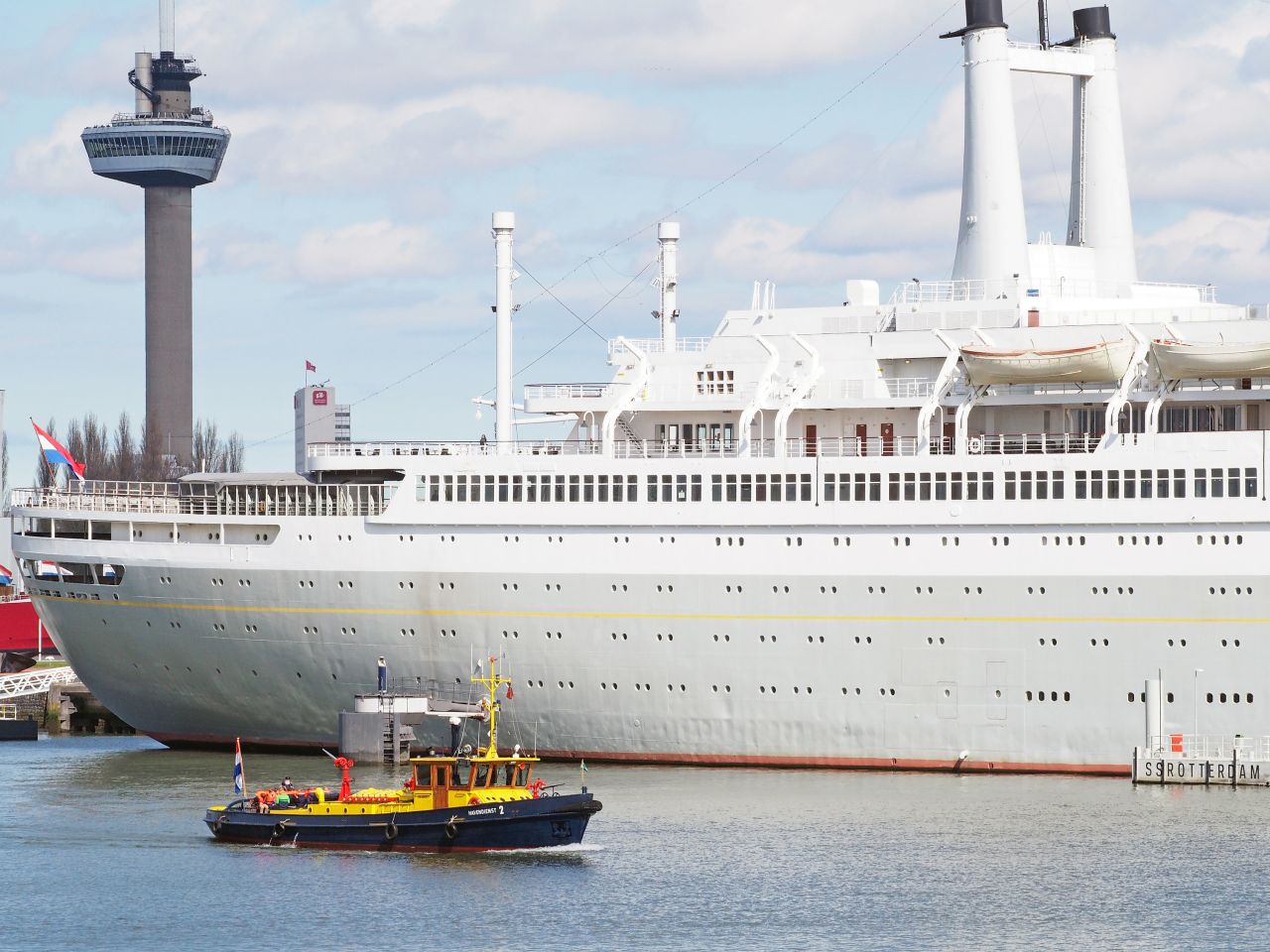
Construction of the “Havendienst 20” began in 1941. Due to the war, the tugboat was not delivered to the Port Authority until 1950. At that time, Rotterdam also had an urgent need for patrol vessels in the harbor. Due to the postwar shortage of materials and the shipyards’ limited construction capacity, it was decided to convert the motor tugboat and adapt it for use as a patrol vessel in the Port of Rotterdam.
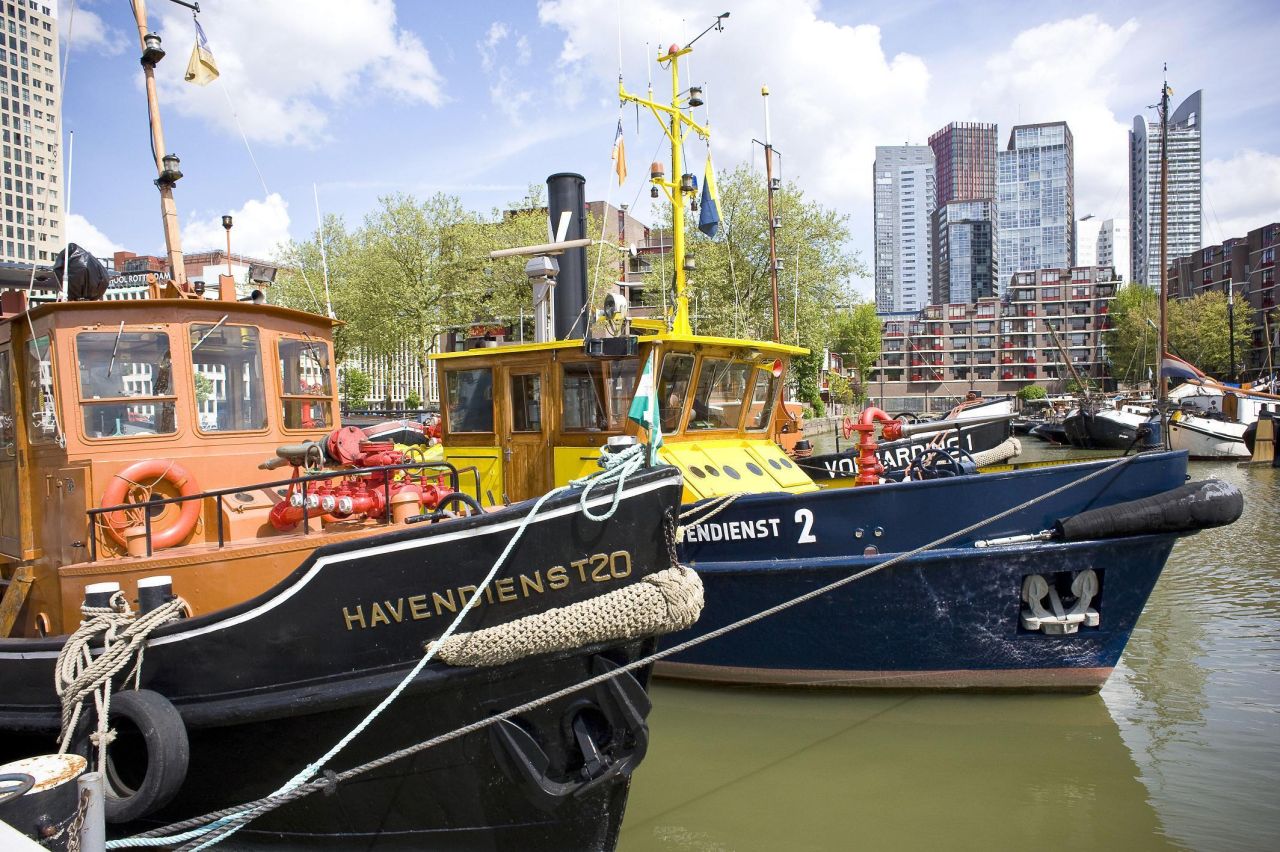
Just as in the shipping industry, the port authority’s service vessels are undergoing a shift toward larger vessels. Its younger and, at the time, more modern sister ship, the “Havendienst 2,” eventually took over. The ‘Havendienst 2’ was designed to pass under the lowest bridges in the Rotterdam section of the Schie. It was the port authority’s first newly built vessel after World War II and thus emblematic of the reconstruction of the Port of Rotterdam. After forty years of loyal service, the ‘Havendienst 20’ became too small to meet modern requirements and was acquired by the museum in 1990.
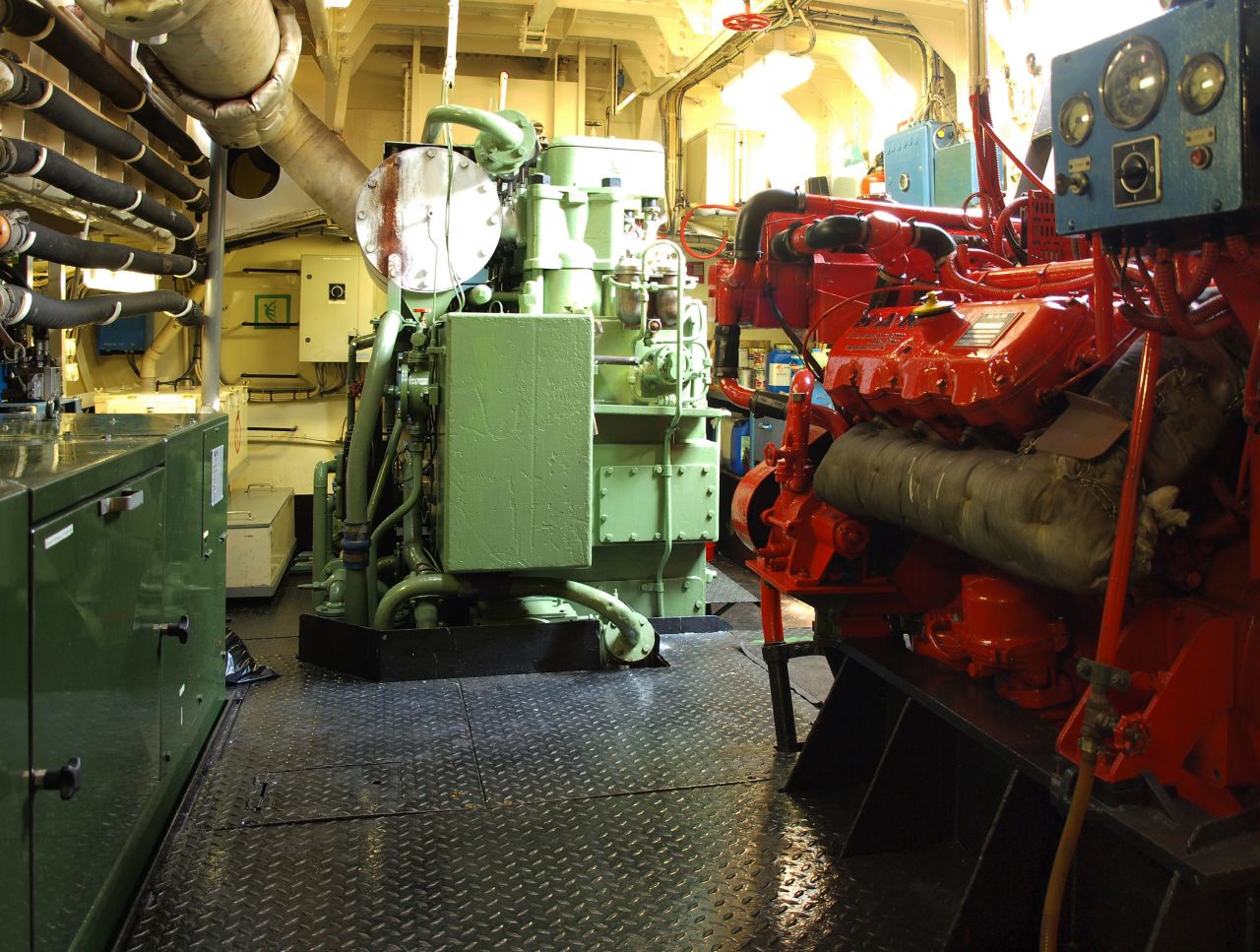
A unique way to explore the harbor
Did you know that we offer the option to rent a historic museum ship for an exclusive cruise through the Port of Rotterdam?
Discover the possibilities
Come learn and explore aboard our ships
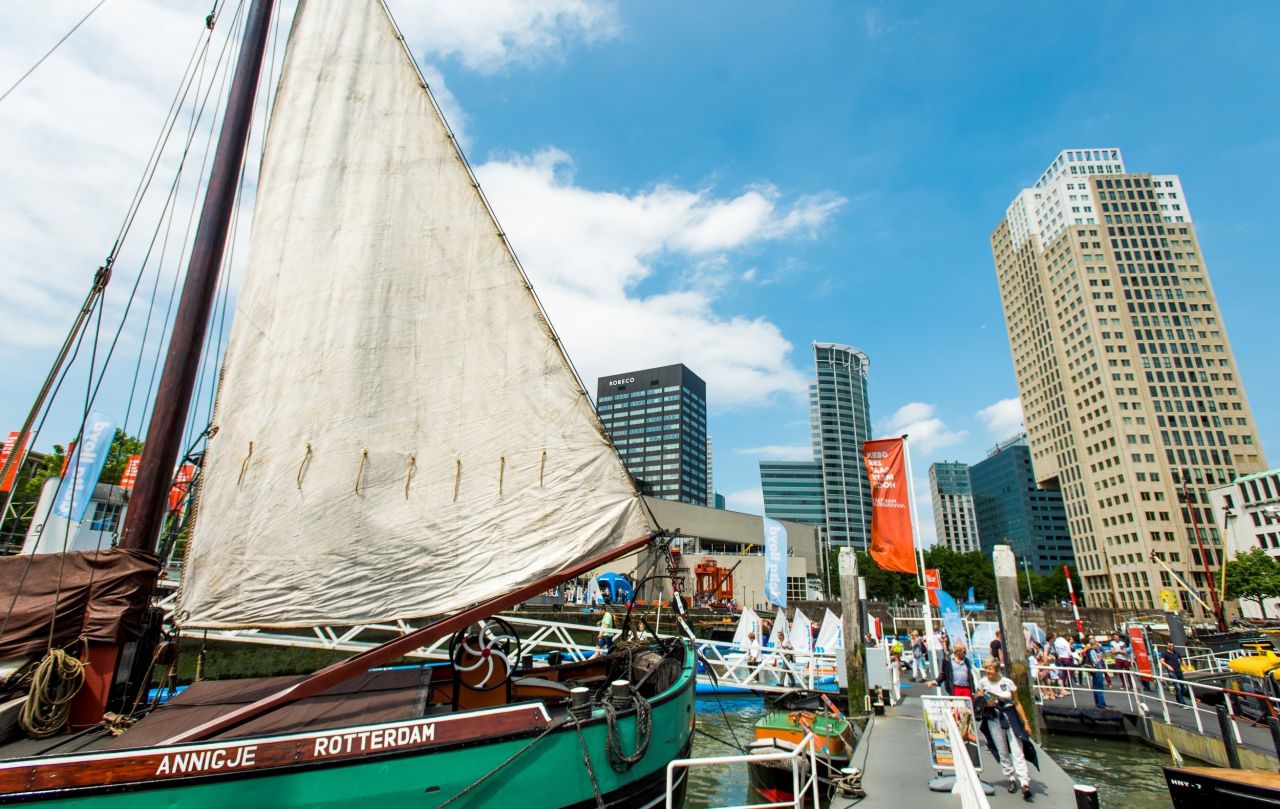
The ‘Annigje’ is one of the highlights of the Maritime Museum. This sailing ship symbolizes inland shipping around 1900, when the port of Rotterdam developed into a hub for inland shipping. Ships came and went with their cargo, and Rotterdam became a true transshipment port. What makes it unique is that the ship is still seaworthy, is over a hundred years old, and is fully furnished in its original style. And you can visit the ship! You’re welcome on board. Here you’ll discover how the skipper and his family used to live and work on board.
Skipper Gerrit Hutten had this steel sailing ship, a Hasselt barge, built in 1908 and affectionately named it after his first wife. The skipper’s main source of income was peat transport. Later, the ship also carried sand, gravel, and, during World War II, hay. To transport as much cargo as possible, most of the ship consists of cargo space.
A tribute to this family of skippers can be seen on the jib
Inland waterway skippers often lived on board with their families. The small living quarters, known as the “deckhouse,” served as their living room, bedroom, and kitchen all in one. Together with his wife and six children, the skipper worked day and night for a meager income. As a tribute, an old photo of this skipper’s family now adorns the ship’s foresail.
A symbol of innovation: from sailing to motorized shipping
In 1933, the “Annigje” was assisted by a “push boat,” a small motorized vessel that pushed the ship, so that the skipper was no longer dependent on the wind to load or unload his cargo. This was a significant development in inland shipping at the time, marking the transition from sail to motorized vessels that began in the 1920s.
What are those oval planks on the side of the ship for?
Those two planks are called “swords,” and they are used on flat-bottomed boats like the “Annigje” to prevent the boat from being blown off course (officially known as “drifting”) and to allow it to sail more or less against the wind.
Until 1972, this Frisian tjalk sailed throughout the Netherlands carrying peat, flax, hay, wood, flaxseed, potato flour, manure, and even shells. Now you can learn all about maritime knots here and try your hand at tying them yourself.
Do you know how to tie sailor's knots?
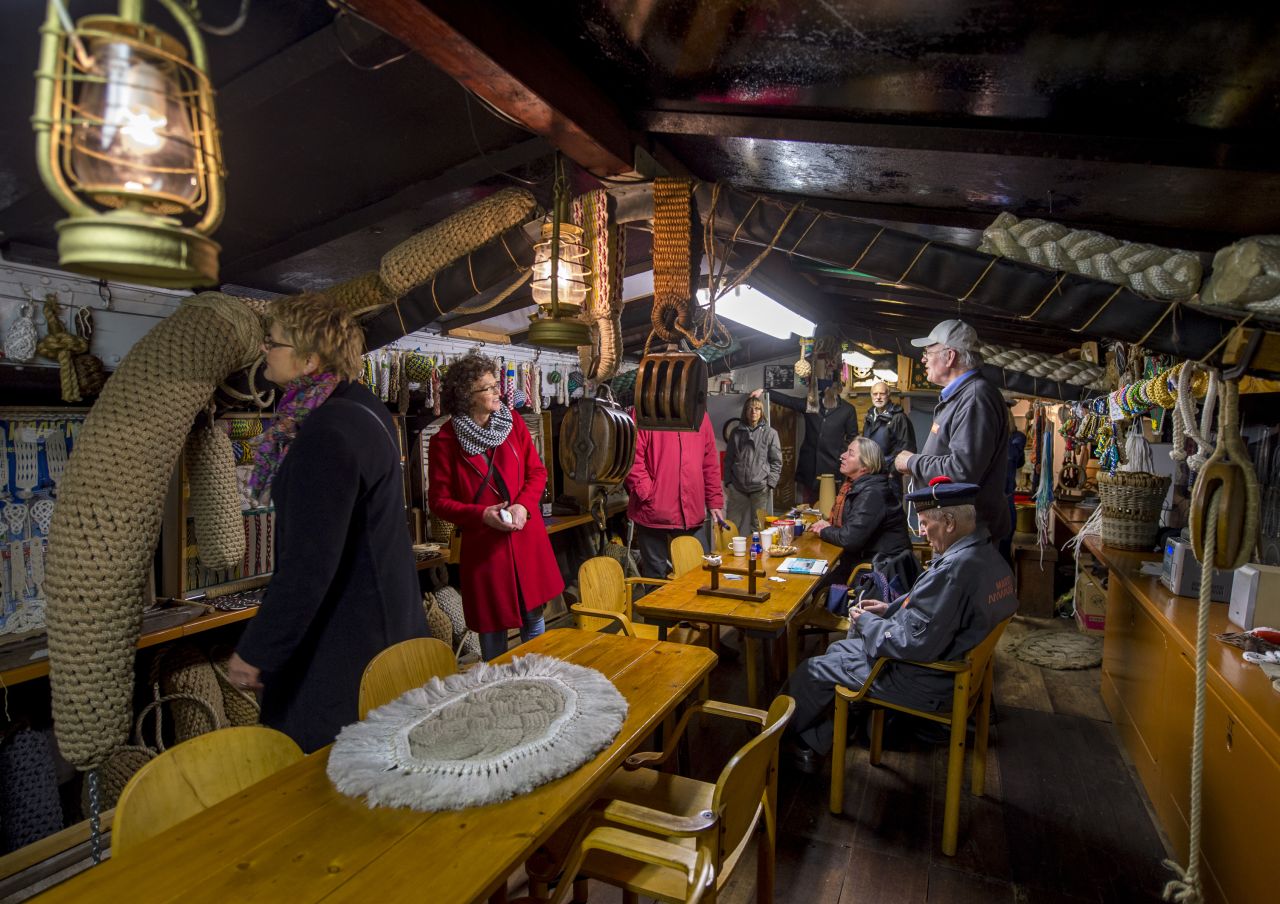
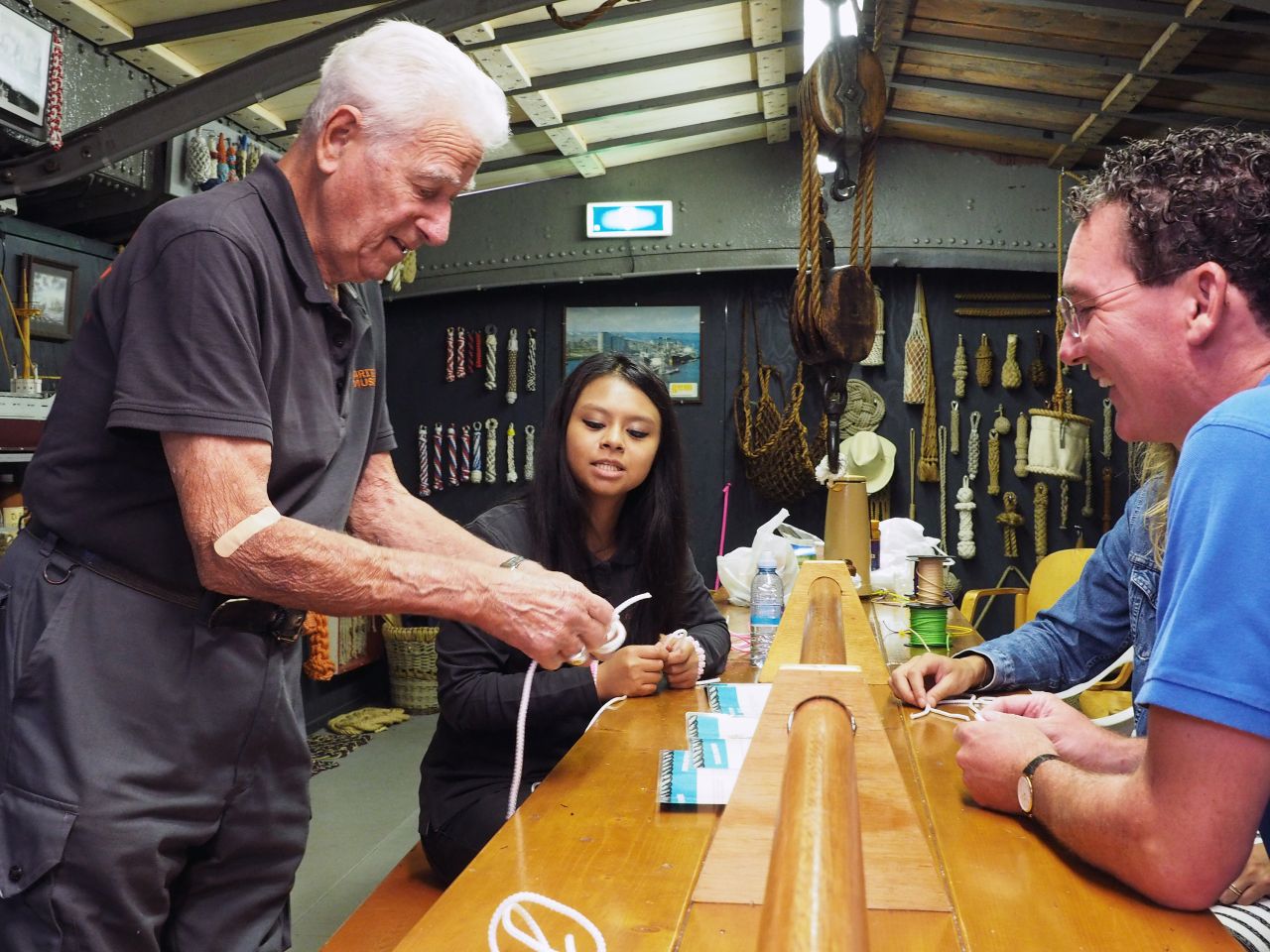
On board the ‘Gruno,’ you’ll learn everything about knots—how to tie a figure-eight knot, a clove hitch, or a bowline, all essential knots in sailing. Come on board and try tying a few yourself, or watch the craftsmanship of our maritime knot experts, who’ll be happy to lend a hand.
The most useful knot in the world: the clove hitch. How do you tie it?
- Loop the loose end of the line—this is called “the working end”—over the line. You now have a loop in the line.
- Pull the loose end through the loop from below.
- Pull the loose end behind the fixed end.
- Pull the loose end through the loop again.
A mnemonic to help you remember this knot: “The little snake (the loose end of the rope) comes out of the pond (the loop), crawls behind the tree (the fixed piece of rope), and goes back into the pond.” Done! The harder you pull on this knot, the tighter it gets. But… when there’s no tension on it, you can always untie it easily.
This ship was supposed to bring in money
This Frisian tjalk, the “Gruno,” sailed throughout the Netherlands until 1972, engaging in what was known as “wilde vaart.” This is an adventurous term indicating that the skipper sailed his ship wherever he could find cargo, rather than to fixed ports. In 1914, father Esse Bond bought this ship (which was then called “Esperance”) and named it “Hendrikina” after his wife. Son Jan Bond bought the ship from his father in 1925 and then renamed it “Gruno.” The ‘Gruno’ carried all sorts of cargo: peat, flax, hay, wood, linseed, potato flour, manure, and even shells. For a long time, this was done under sail, as skipper Jan didn’t have an engine installed until 1952. As a result, the tjalk was no longer dependent on the wind. There is plenty of cargo space on board. That makes sense, since the ship had to bring in money! Living quarters are located in the fore and aft cabins. You’re welcome on board! Discover how skippers used to live and work on board.
The ‘Geertruida’ is a custom-built boat, designed specifically for the route it will sail. It is tailored to the canals, locks, and bridges along the route. This ensures that you can navigate through everything.
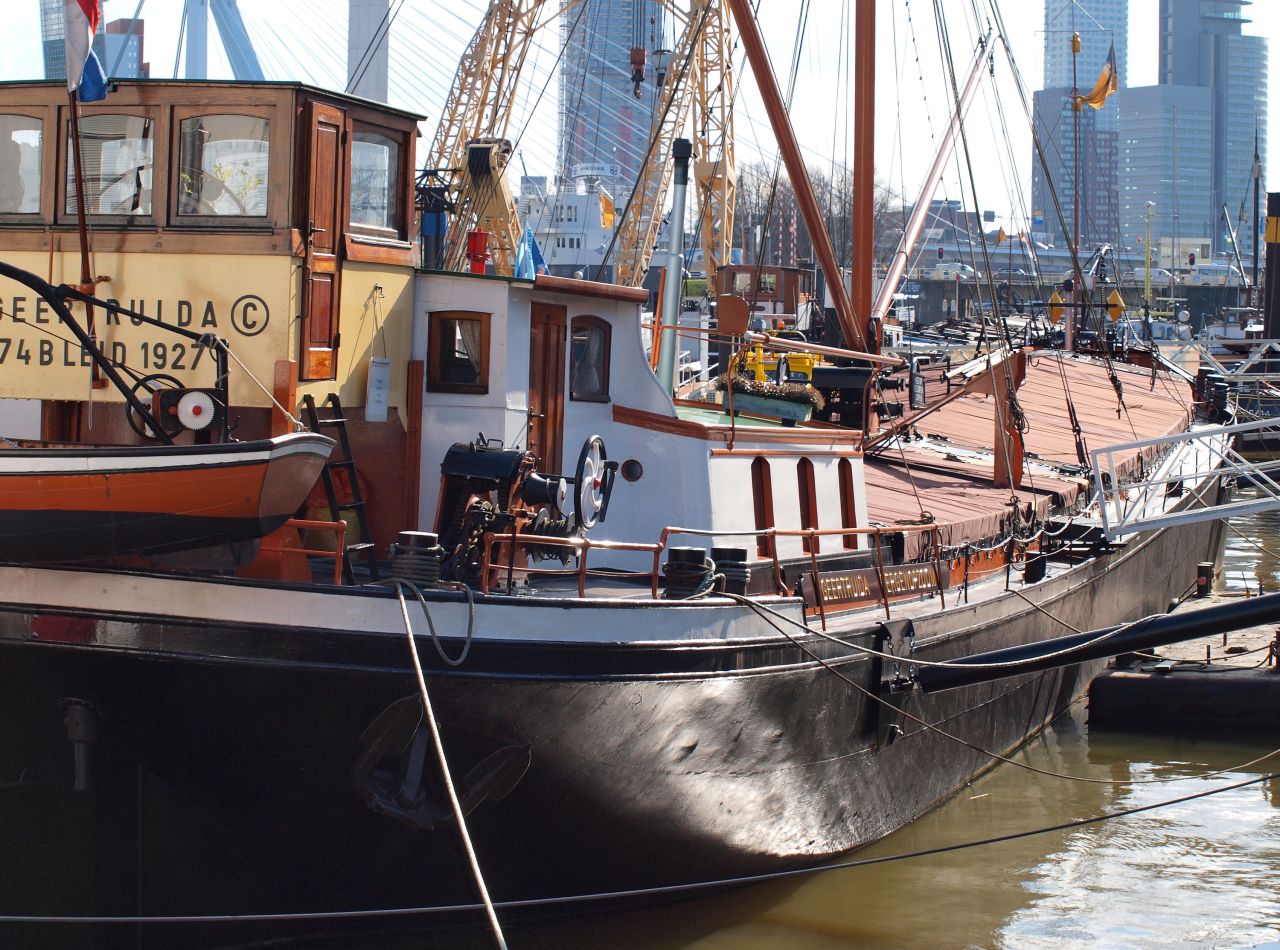
In 1906, the “Geertruida” was launched by the Gebroeders Boot shipyard in Leiderdorp. She was named after the wife of owner and skipper Hendricus Johannes Maas. The ship was primarily used to transport building materials to Brussels. The ‘Geertruida’ regularly shipped sand, stone, and gravel to the Belgian capital. For the first 50 years, the ship was towed by tugboats. Later, the ‘Geertruida’ was fitted with an engine, allowing it to sail under its own power to Belgium, as well as regularly to Germany.
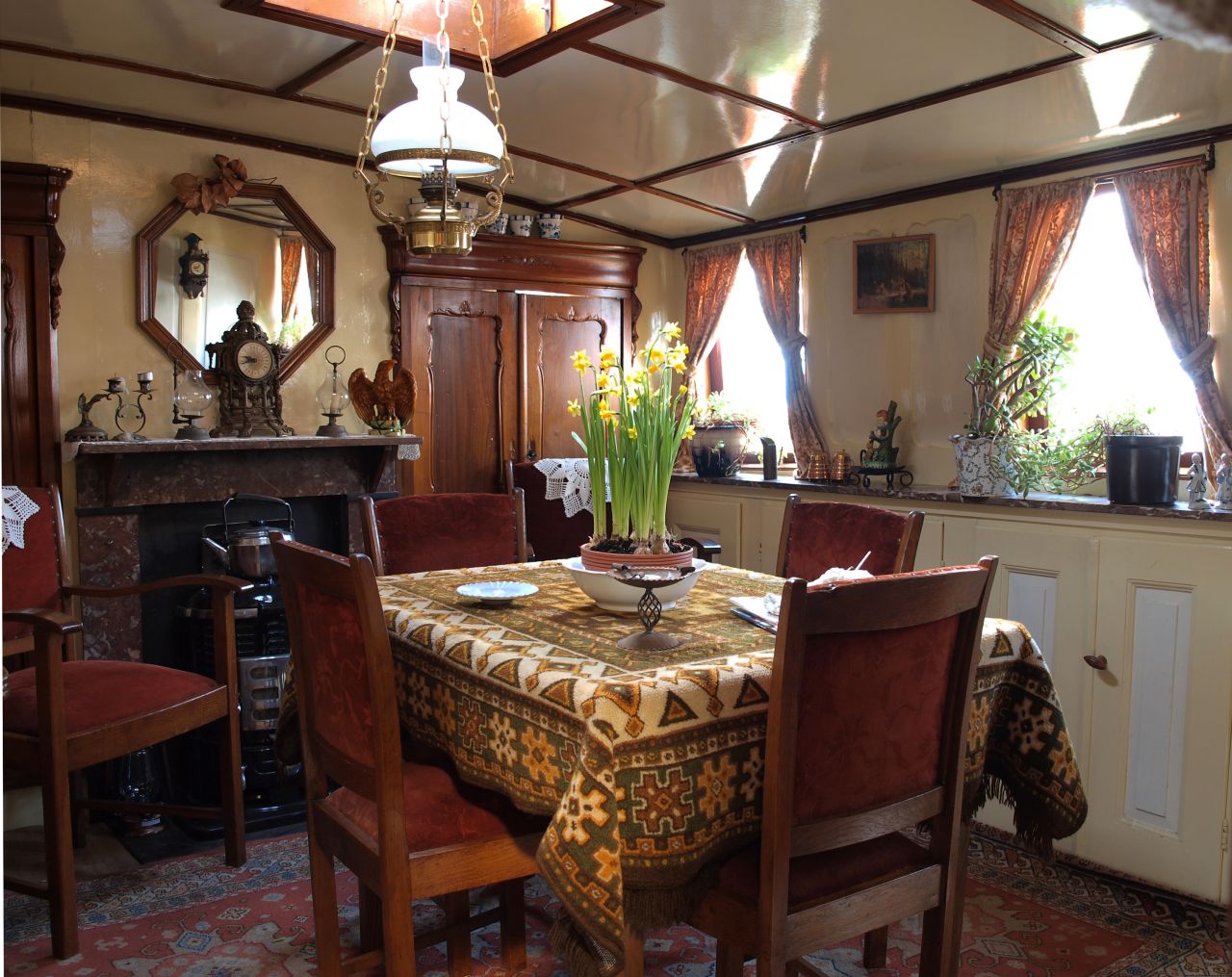
The Maas family continued to transport goods to the hinterland of Rotterdam well into the 1970s.
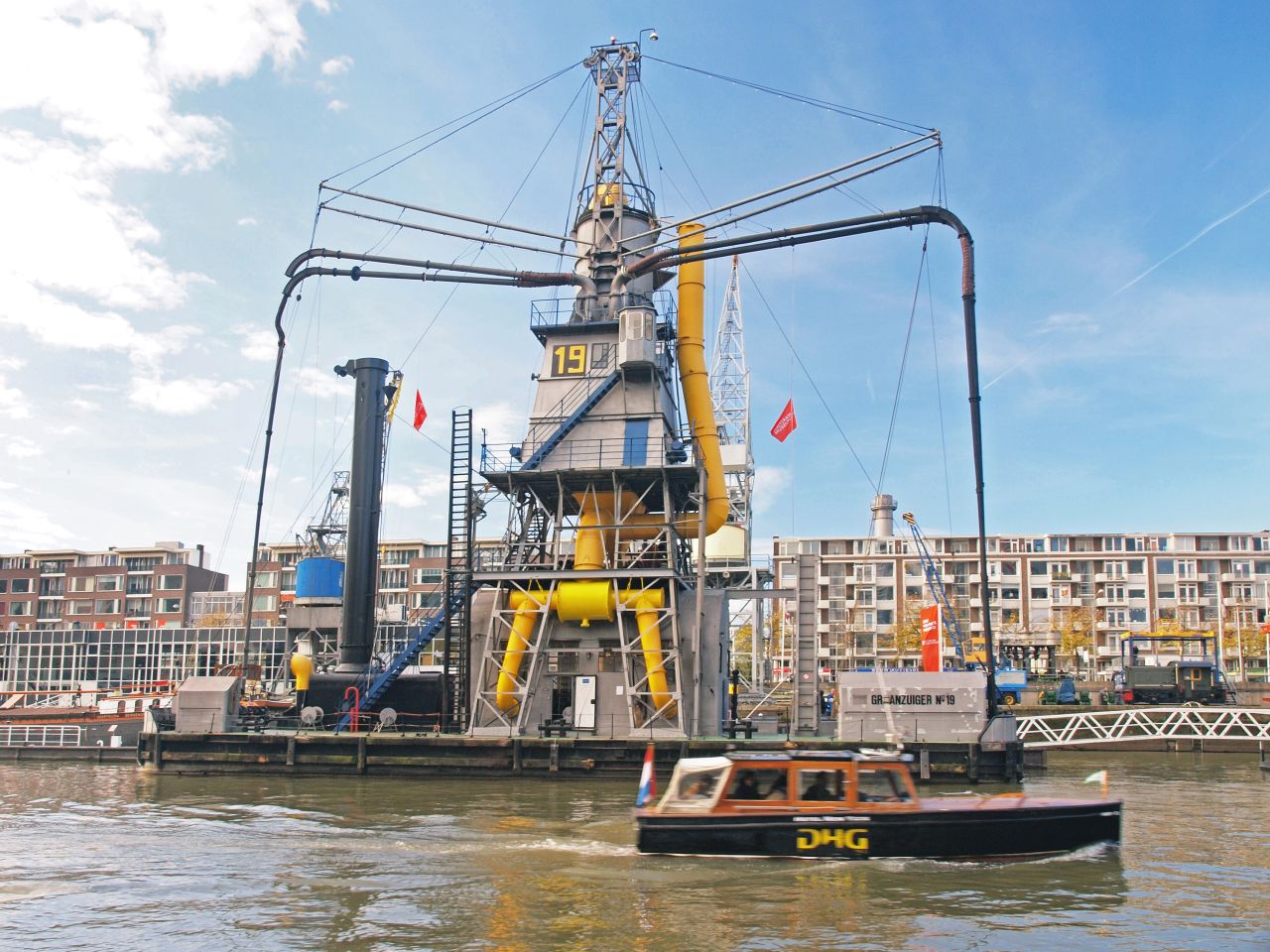
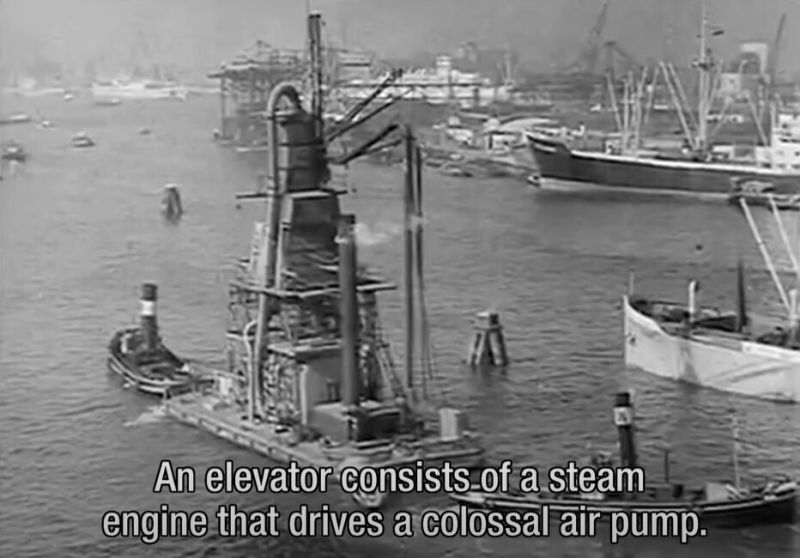
Elevators are massive “vacuum cleaners” that handle the loading and unloading of dry bulk cargo. The cargo is sucked out of the ship and weighed in the elevator. It is then dumped into another, smaller ship and transported further.
The City Grain Elevator 19 is on display in our museum harbor.
A competitor? Not at all!
At the beginning of the last century, ocean-going ships brought grain, seeds, beans, peas, nuts, and rice from all over the world to the Port of Rotterdam. Elevators were used to transship these products. The introduction of elevators around 1900 caused a huge uproar among the dockworkers. In their view, mechanization meant a loss of jobs. Once in the port, however, it soon became clear that the faster transshipment method actually generated more ships and thus more work.
The Stadsgraanzuiger 19 is primarily used for the transshipment of grain. A steam engine powers two enormous air pumps. This creates a vacuum, allowing the grain to be sucked up.
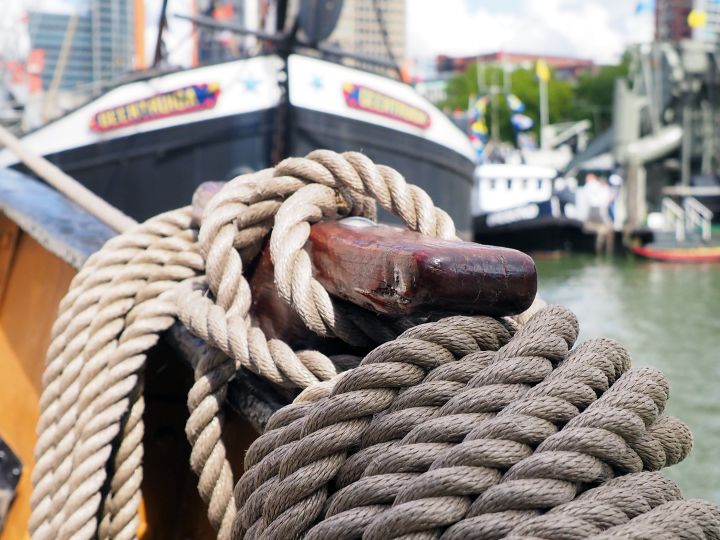
In the late 1920s, a new type of vessel was developed for coastal shipping: the “motorcoaster.” It represented a true innovation that changed coastal shipping forever. These ships could sail faster (the ‘Zeemeeuw,’ for example, reaches a speed of over eight knots, about fifteen kilometers per hour), but more importantly, travel times could be planned much more effectively. Skippers were no longer completely dependent on weather conditions and could suddenly estimate quite accurately how long a voyage would take. The ‘Zeemeeuw’ is a fine example of innovation from that era.
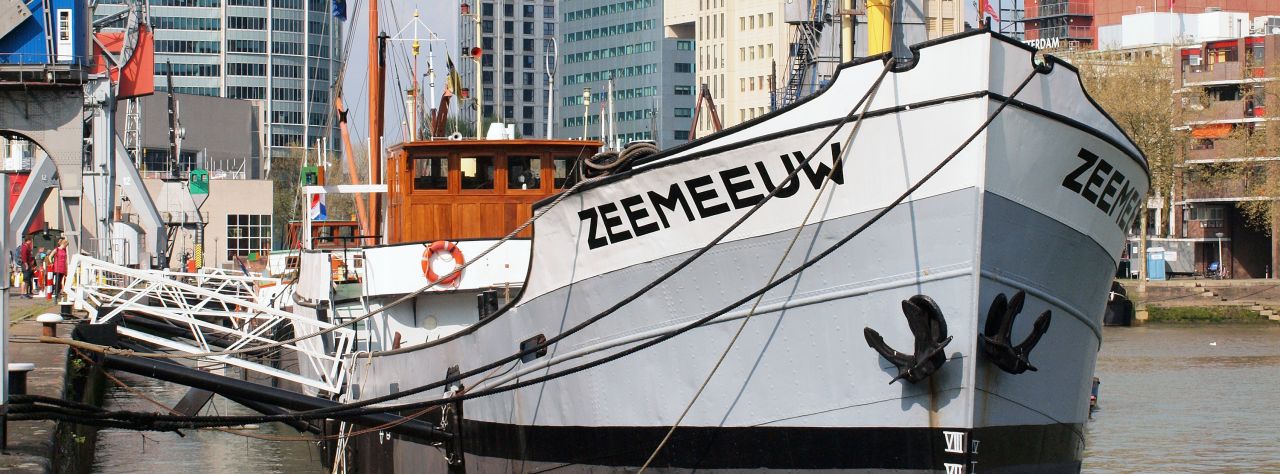
The fleet of Dutch motor coasters accounts for a large portion of freight transport between various European ports. Thanks to their practical design and shallow draft, these coastal vessels can also easily reach ports in the German hinterland. The fleet served as a vital link between the hinterland and the coastal regions of neighboring countries. The fleet of gray ships, also known as the “little gray devils,” was well-organized; the vessels were well-maintained and operated very economically. As a result, the Netherlands quickly developed a monopoly position relative to the German and English small-scale merchant shipping sectors.
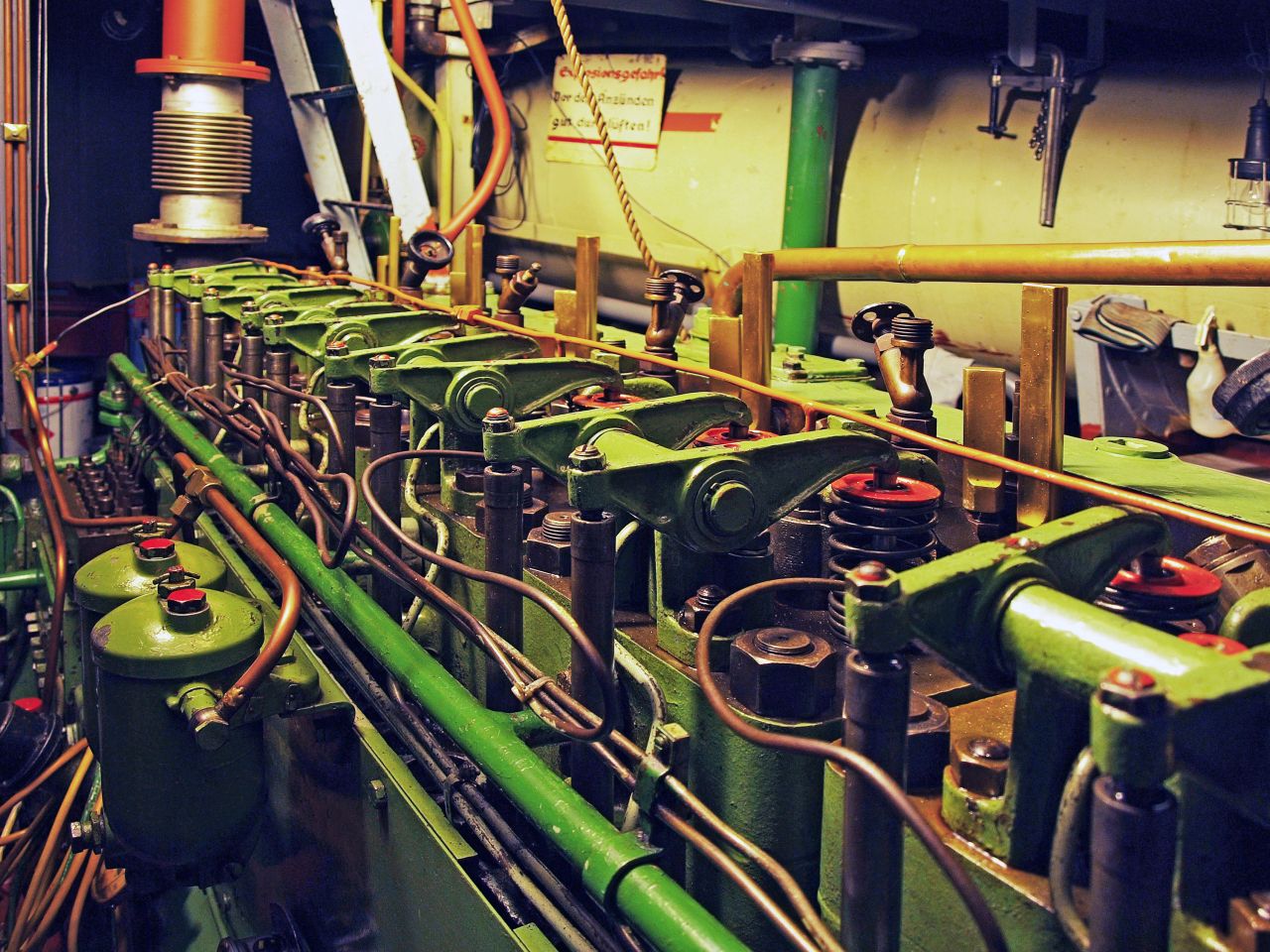
Step aboard and be inspired by the innovation of the past
You’re more than welcome to come aboard and take a closer look at this unique ship. Our tip: take a peek inside the wheelhouse, stand at the helm for a moment, and let your imagination run wild. Ahoy, sailor!
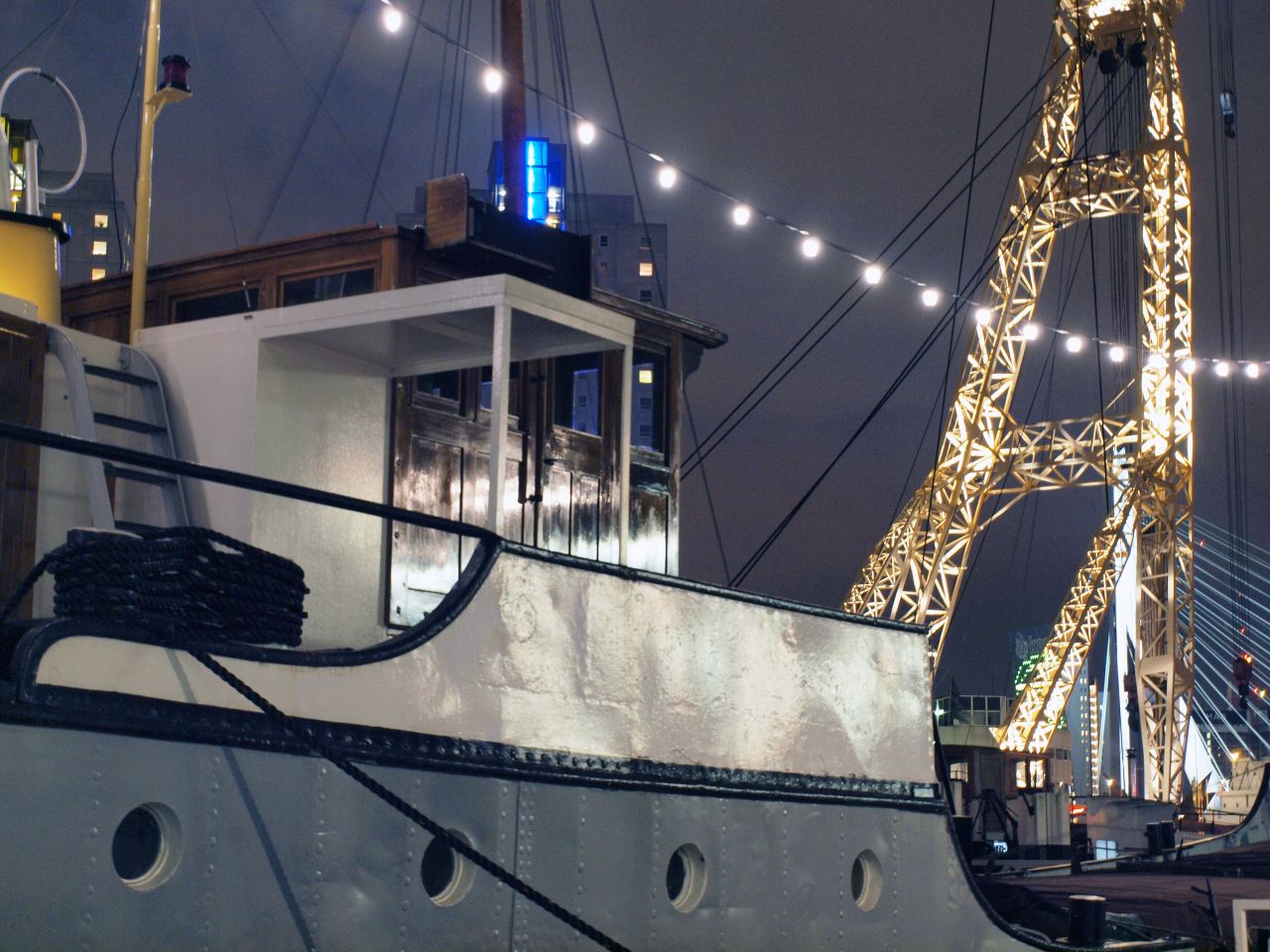
“Simson” is the powerhouse of the Maritime Museum and was, in its day, the largest floating steam crane in the Benelux. You can now visit this remarkable crane, and during the summer months, you can even relax in one of the beach chairs with a spectacular view of the Erasmus Bridge while enjoying a drink. The cable shaft is an experience in itself!
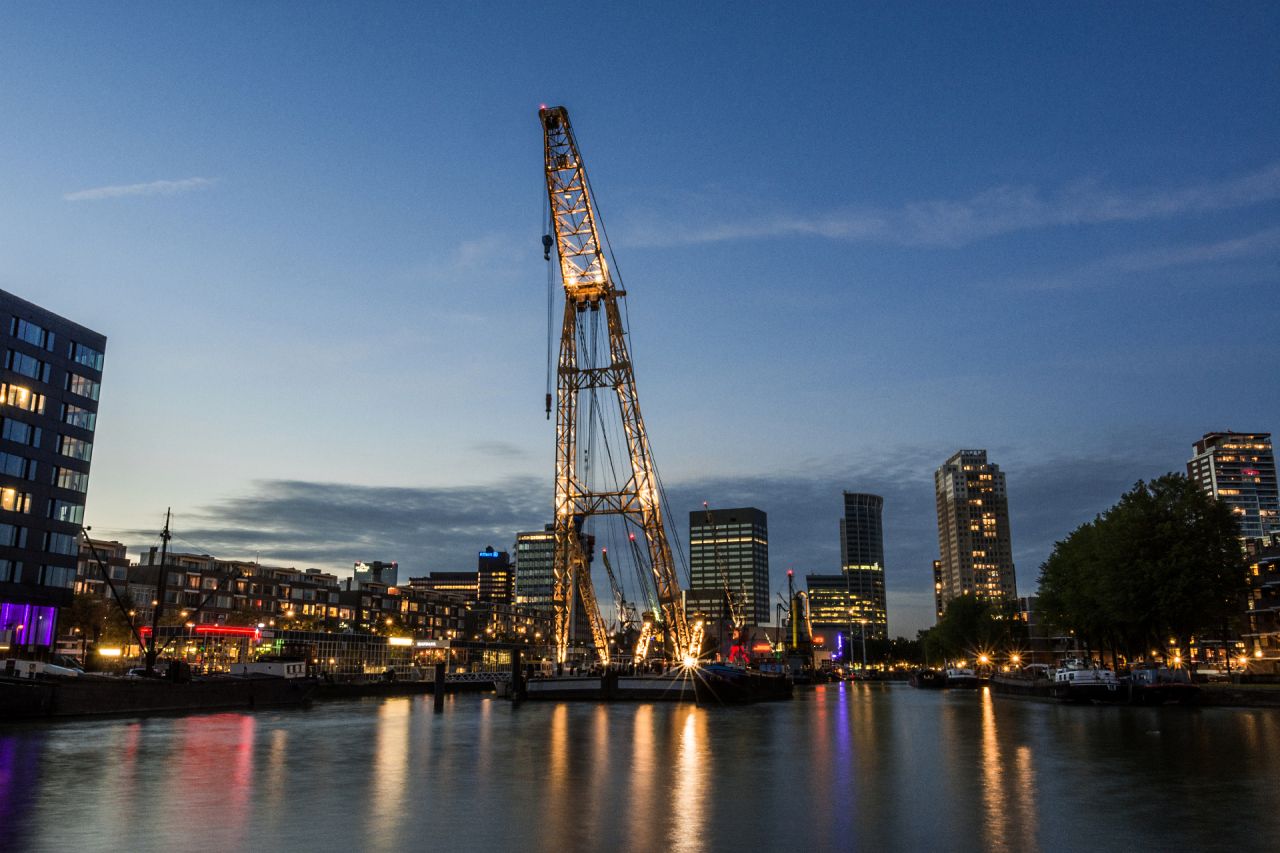
In 1958, the ‘Simson’ was permanently stationed in the Port of Rotterdam. It was specially built to lift heavy loads. Floating derricks are used for tasks such as loading or unloading locomotives, hoisting bridge sections or large structural components, raising sunken ships, or moving heavy harbor cranes. Derricks like this one assist in the construction of quays, tunnels, and prefabricated sections. The ‘Simson’ cannot sail under its own power and is towed to the location by tugboats. It does, however, have a large steam boiler on board. This ensures that the winches can operate for the hoisting work.
This tugboat celebrated its 100th anniversary in 2015. The ‘Maashaven’ belonged to the category of smaller tugs operated by the Smit shipping company and was primarily used for lighter towing work in the harbor and for “hooking up” tugboats that were then towed to Germany behind the much larger and more powerful Rhine tugs.
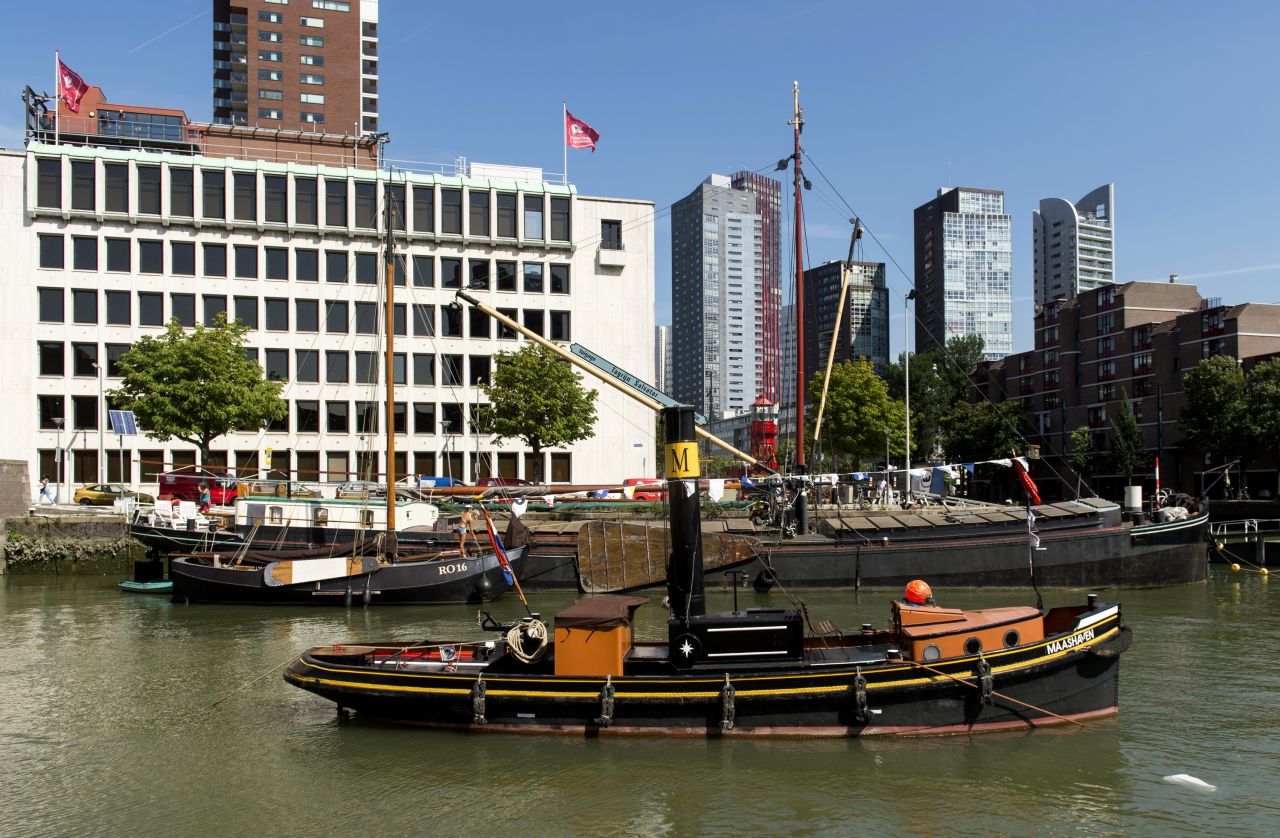
The tugboat “Maashaven” was originally part of a series of six steam tugs built for the Nederlandsche Stoomsleepdienst, formerly P. Smit Jr. In the last century, this tugboat service owned a large number of tugboats that were often referred to in Rotterdam as “Piet Smit’s yellow-striped tugs.” Piet Smit’s tugs assisted seagoing vessels in the ports of Rotterdam, towed grain elevators, made trips with barges to Zeeland, and also performed other towing work as needed.
The ‘Maashaven’ was converted into a motor tugboat in 1936. In March 1944, the vessel was requisitioned by the German Wehrmacht and taken to Germany. Fortunately, the ‘Maashaven’ was recovered at the end of World War II and returned to service with Piet Smit in June 1946.
After changing names and owners several times, this tugboat was purchased in January 1988 by Mr. Bijl of Rotterdam, who restored the vessel to its original name, ‘Maashaven,’ and rebuilt its exterior to the condition in which it was launched in 1915.
However, the engine room now houses a Scania diesel engine instead of the original triple-expansion steam engine. Since 1998, the ‘Maashaven’ has been part of the Maritime Museum’s fleet.
On the waterfront
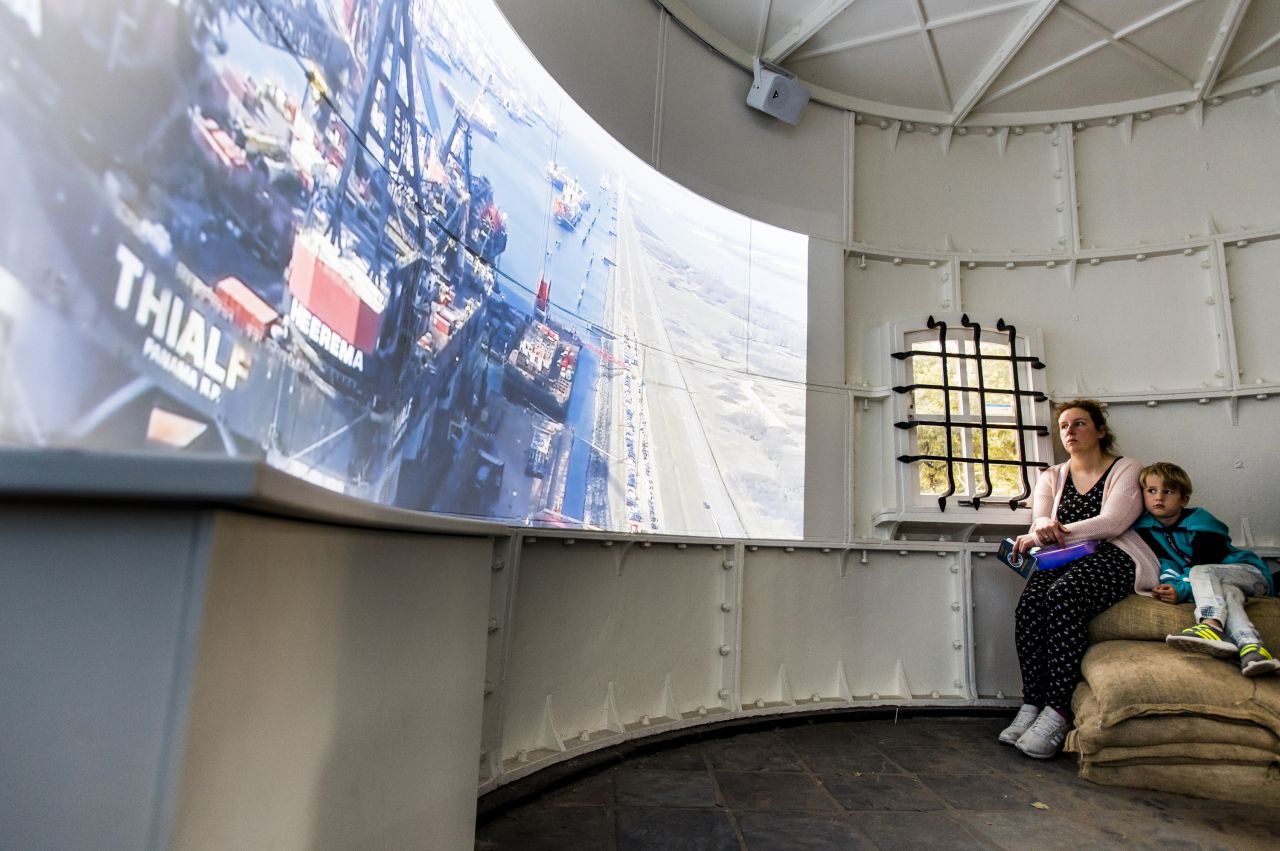
The Lage Licht Lighthouse is the starting point for your visit to the Maritime Museum Harbor. Here you can watch a film about the history of the Port of Rotterdam: 100 Years of the Port in 7 Minutes. In the past, this lighthouse guided ships safely into the Port of Rotterdam; today, it serves as the striking starting point for your exploration of the port’s history, right where it all began long ago.
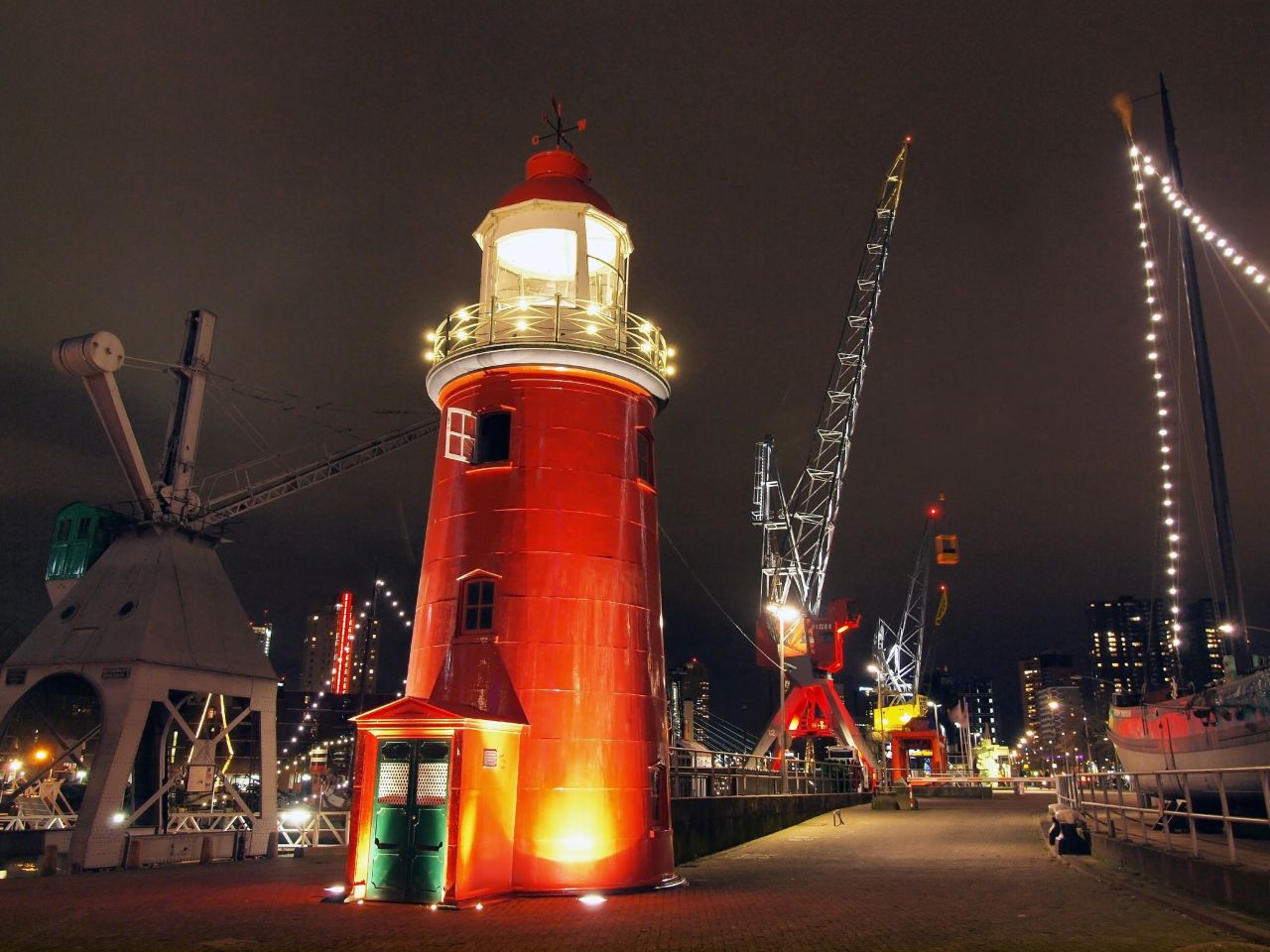
There are eleven large lighthouses and four smaller ones along the Dutch coast. These lighthouses warn of cliffs, straits, estuaries, and harbors at night and during storms. Originally, this was done with an open fire—hence the name “lighthouse”—and later using mirrors, lenses, and a powerful lamp. The first lighthouses at Hoek van Holland, the “high” and “low” lights, were erected during the construction of the Nieuwe Waterweg (1866–1886). The lighthouses were necessary to safely guide shipping toward the port of Rotterdam. How? It’s actually quite simple. If the helmsman on the ship aligns the lights of both lighthouses exactly in a straight line and follows that line, he will arrive precisely at the mouth of the Nieuwe Waterweg.
Have you ever been inside a lighthouse?
After the construction of the first Maasvlakte in the early 1970s, new lighthouses had to be built along the Nieuwe Waterweg to form that line of lights. The Lage Licht was decommissioned in 1967 and can now be seen in the Leuvehaven. Would you like to come inside and take a look?
Can you see them yet?
Our stately guardians can be seen from a distance. Cranes have been making the handling of general cargo easier for many years. These magnificent giants—both large and slightly smaller—in the Port of Rotterdam all have an impressive track record.
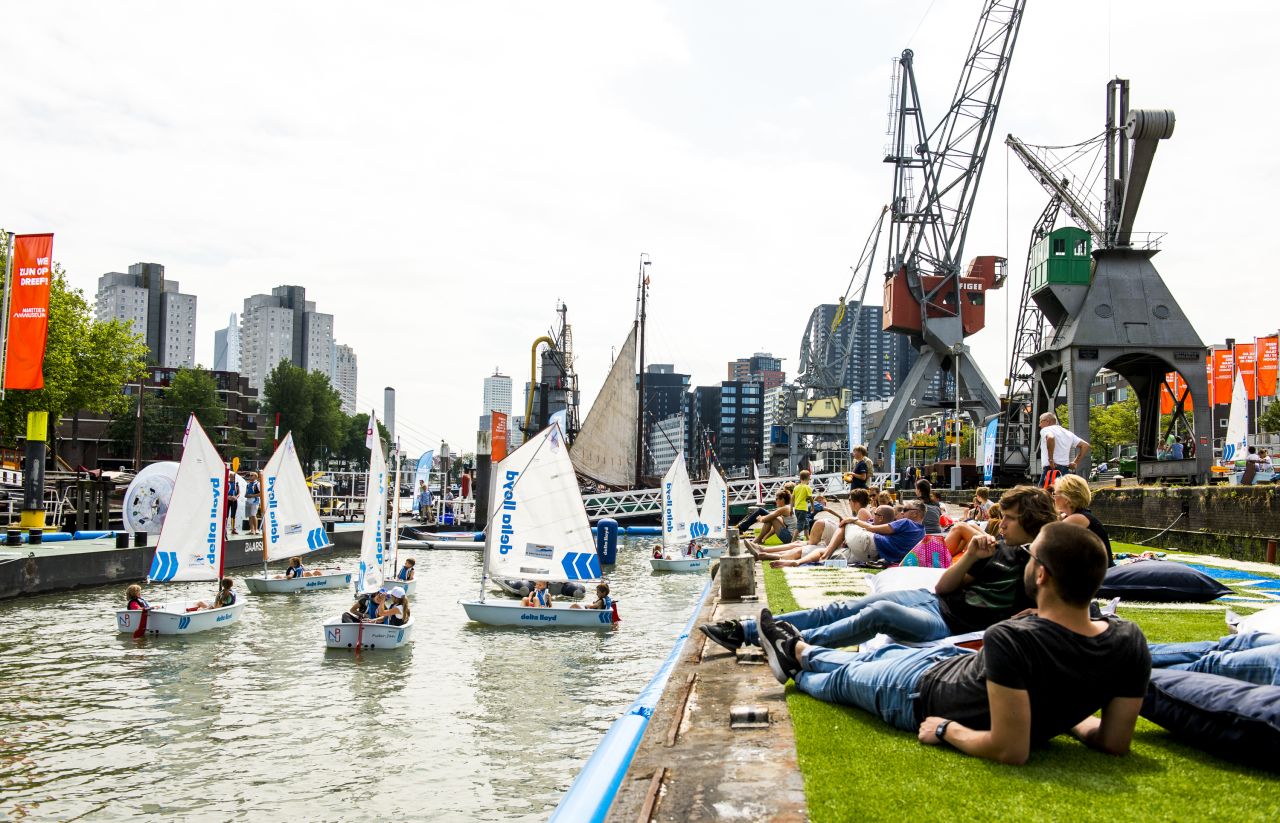
The water crane, the Boele 10 steam crane, the red Figee, and the yellow Figee. All of them have been restored with the help of volunteers. It goes without saying that this was no easy or quick job. The Figee cranes are best known for the 5- and 8-ton models that were widely used, for example, at the Seaport fruit pier and Seabrex Merwehaven. The colors of the cranes were company-specific: yellow for the municipality, red for the Pakhoed company, and blue for Thomson. The crane operator was and remains a highly responsible profession in the port.
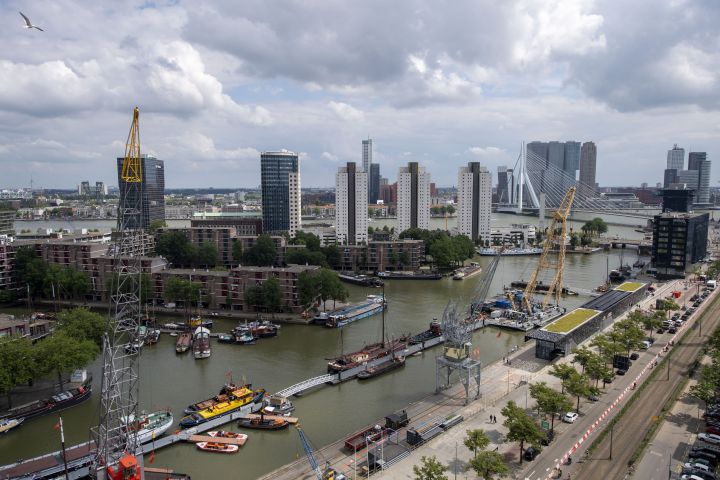
The sailing ship ‘Helena’ is a two-masted stevenaak built in 1875 and owned by the ‘Het Rotterdamse Zeilschip’ Foundation. The ship is moored in the museum harbor. This river sailing ship is the oldest iron-hulled sailing inland vessel in the Netherlands.
Designed for the Rhine
In 1875, the Jonker shipyard in Kinderdijk was commissioned to build the stern-rigged barge “Helena.” The ship was specially designed for cargo shipping on the Rhine, from Rotterdam to Strasbourg. Due to the rapid development of diesel engines and the construction of numerous bridges across the Rhine, sailing ships were soon unable to compete.
After many years of loyal service as a sailing two-masted vessel, the ship was sold in 1911, after which the deckhouse was moved aft to create more cargo space. The mainmast was also removed at that time. The mizzenmast was moved to the mainmast deck to serve as an auxiliary mast. From that point on, propulsion was provided by a pusher.
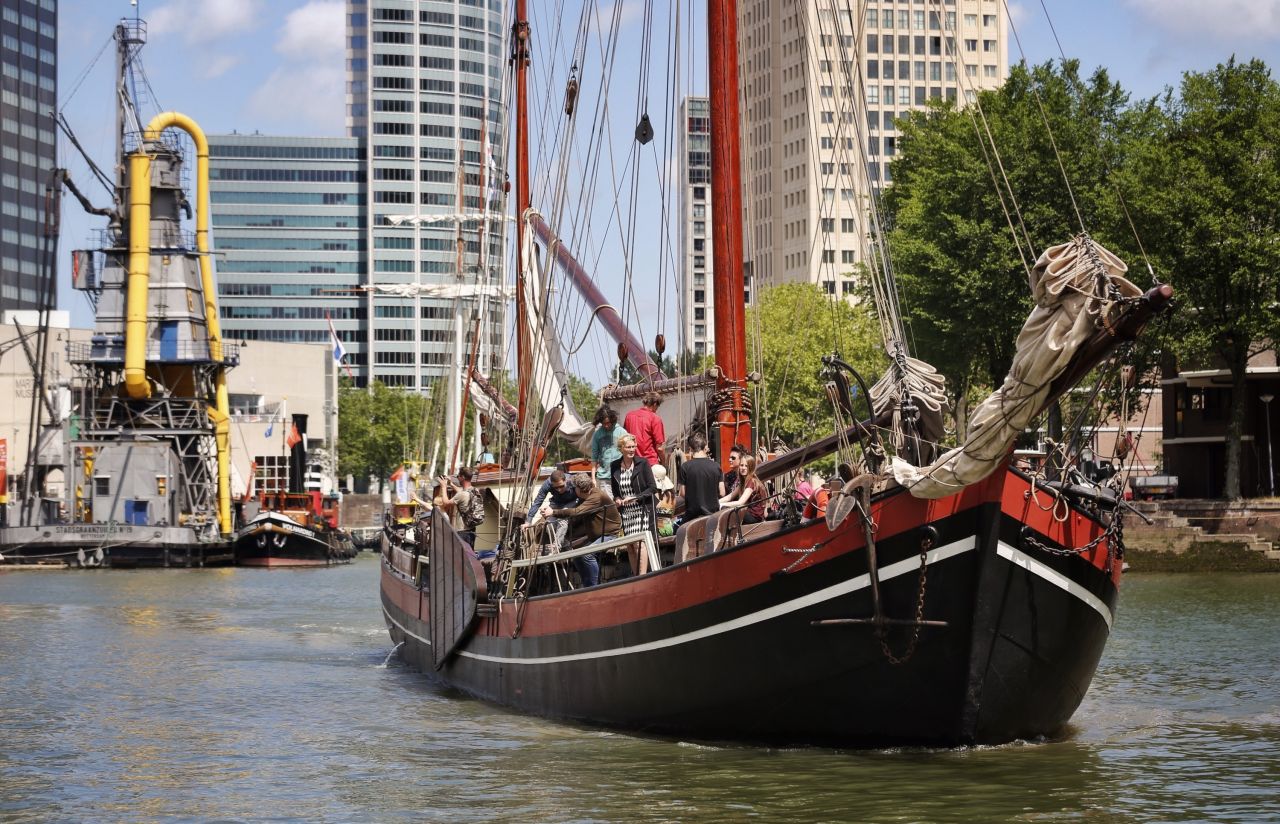
The ship, then named “Antonius Maria,” remained in service as a Rhine barge until it was rammed from behind in the 1950s. The ship sank, was salvaged, and subsequently served as a tugboat for flatboats in the ports of Rotterdam. From 1961 onward, she lay idle, renamed ‘Argus,’ and in 1979 she was finally offered for scrapping. However, she was not scrapped, and nearly 10 years later, Bart Vermeer discovered the hull and purchased it. Over the years, it became clear to him that the restoration was too extensive to undertake privately, and in 1998, the Rotterdam Sailing Ship Foundation took over the ‘Helena’ from him.
A floating monument
Following an extensive museum-quality restoration, the ship has been fully restored to its authentic condition. All the ironwork was traditionally forged and riveted, the deckhouse was rebuilt, the original rigging was restored to its former glory, and the interior was returned to its original style. The ship has been classified and registered by the Ministry of Education, Culture, and Science as a sailing monument of great cultural and historical value. The “Helena” supports itself by offering boat tours for groups of up to 48 people.
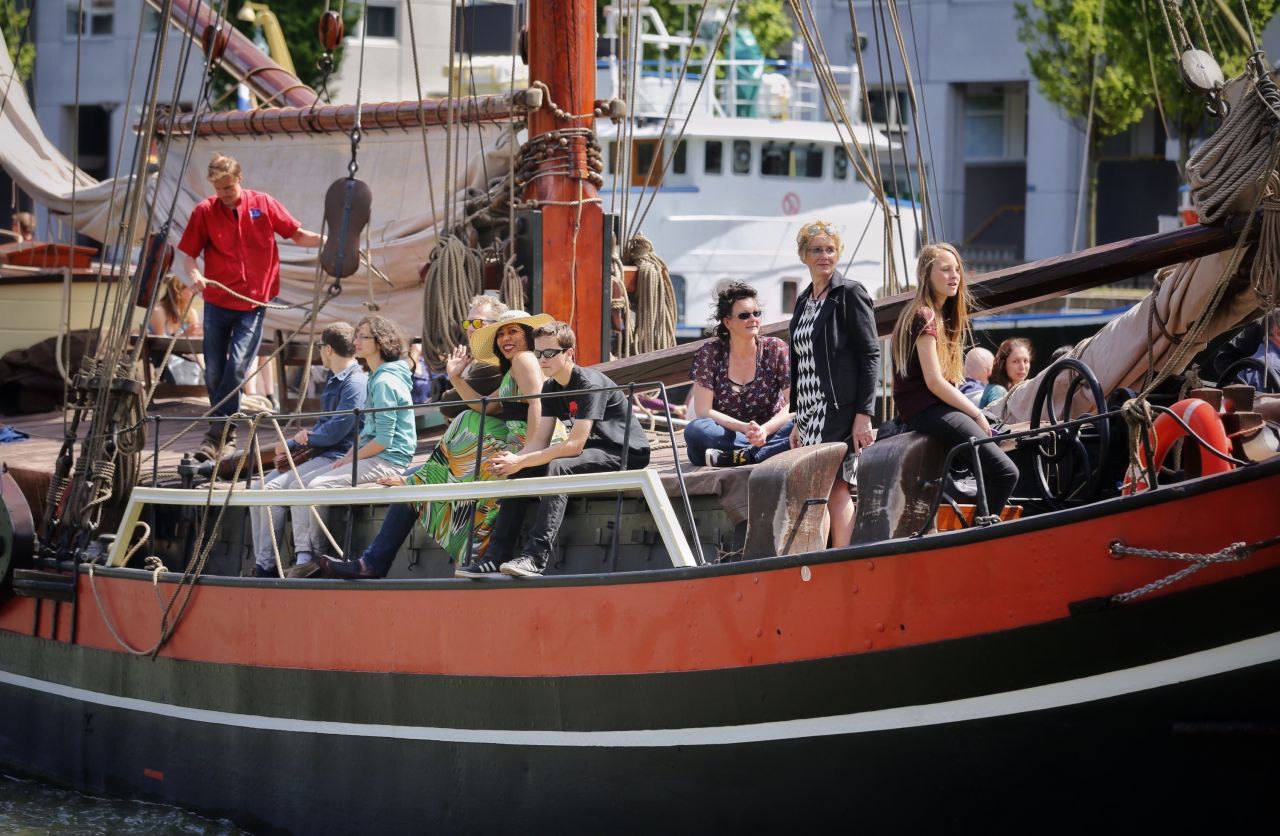
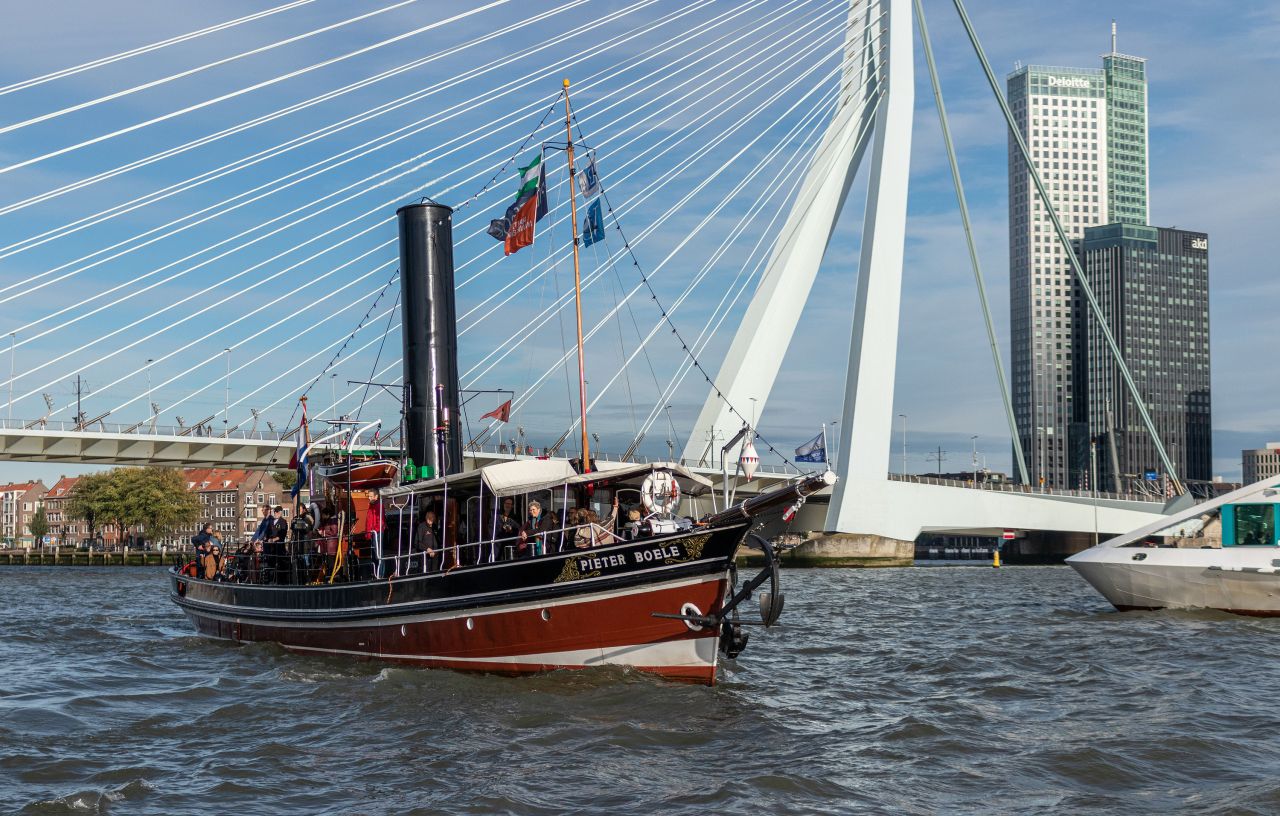
The “Pieter Boele” is one of the highlights of the Maritime Museum. It is the only surviving Rhine steam tug. This unique vessel is permanently moored in Dordrecht’s historic harbor but regularly sets sail for the Maritime Museum Harbor.
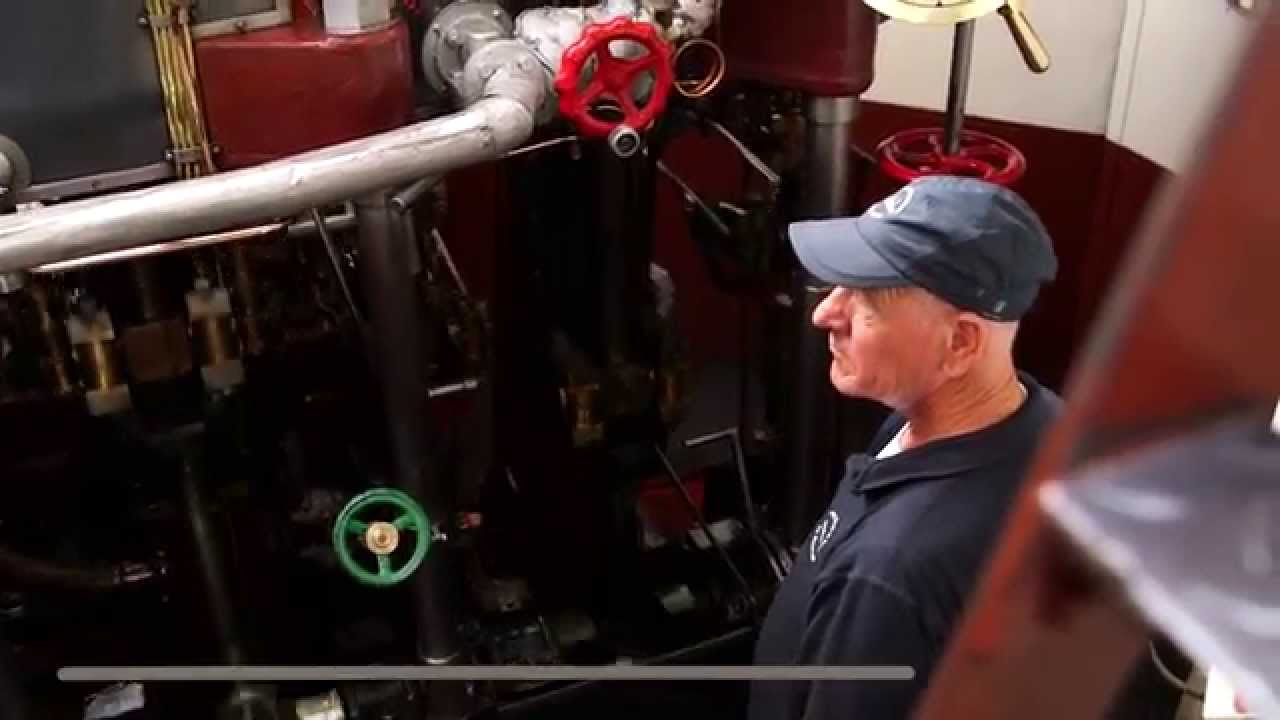
The ‘Pieter Boele’ was built in 1893 at the Boele shipyard. This steam tug was designed to pull barges on the Upper Rhine. At that time, inland waterway vessels often lacked their own propulsion. For this reason, a steam tug was frequently hired, in conjunction with other vessels, for river voyages. The ‘Pieter Boele’ was one of the last steam tugs, replaced in 1965 by the rise of modern push boats. After that, the steam tug remained in service at the Boele Bolnes shipyard as a management vessel. The ‘Pieter Boele’ is on loan to the Dordt in Stoom Foundation, where volunteers maintain the ‘Pieter Boele’ so that the ship can continue to sail.
Did you know you can rent the Pieter Boele?
The Maritime Museum offers the opportunity to charter the Pieter Boele for an exclusive cruise through the Port of Rotterdam.
A unique experience on a ship with a story, a floating piece of history with a skipper who has often sailed it himself, such as one of the steam tugs or a former service vessel from the harbor. Be sure to ask about the packed lunch or snack platter for on board!
Would you like to book a ship?
Call us at 010 4029 264 for more information or to make a reservation, or send an email to sales@maritiemmuseum.nl with your question and contact information.
Contact us